Stop Saying Energy When You Mean Electricity
Part 4 of 4 · The Thermal Series
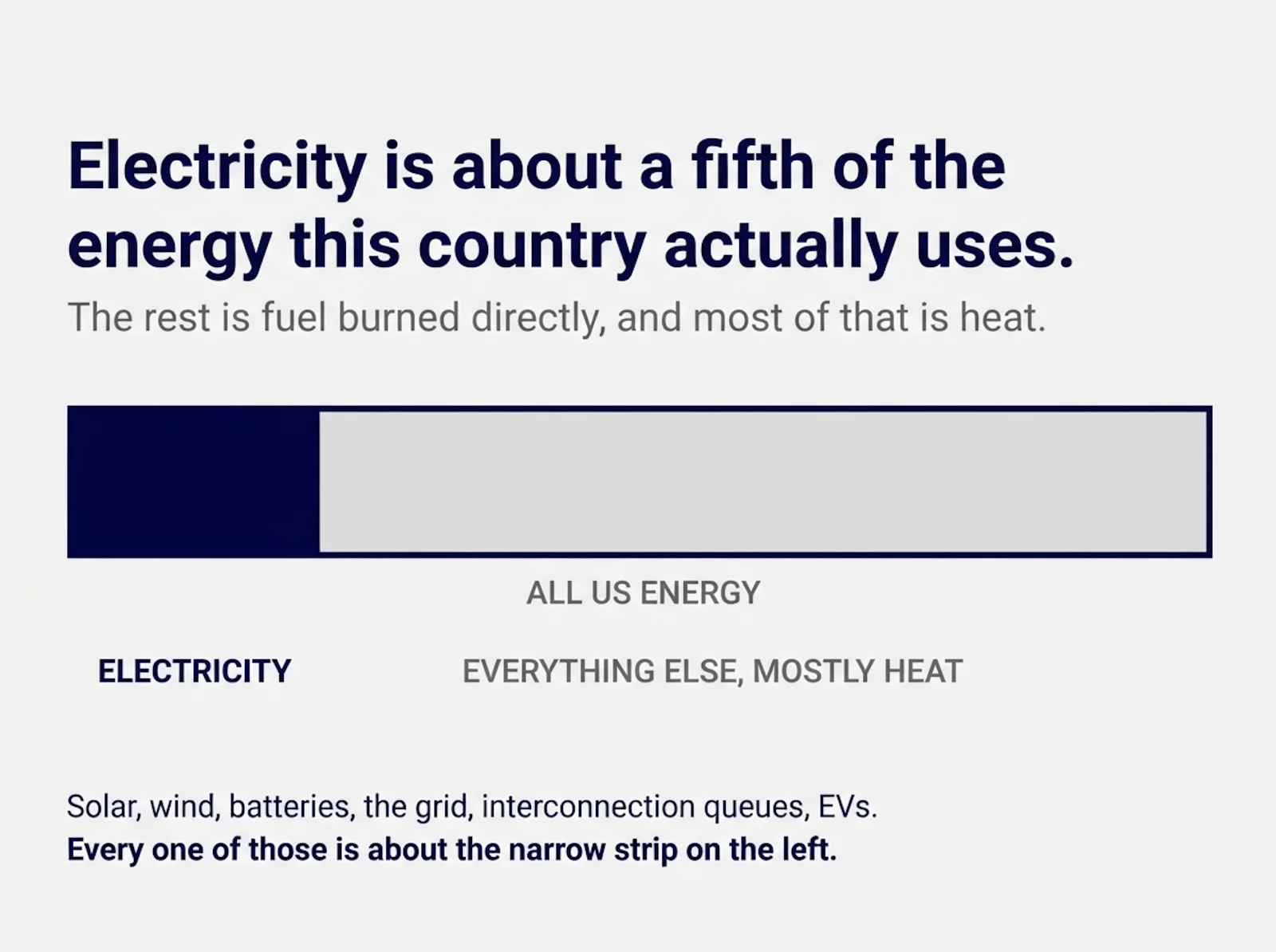
Electricity is roughly a fifth of US final energy consumption. We have organized an entire climate conversation around the smaller share, and the part we leave out is mostly heat.
By Jeff Nichols
Listen to how we talk about clean energy in this country and you’ll notice something. Solar, wind, batteries, the grid, interconnection queues, transmission lines, electric vehicles. Every one of those is about electricity.
Now ask what fraction of the energy a city actually uses is electricity.
In the United States, electricity accounts for roughly a fifth of final energy consumption. The rest is fuel burned directly: gas in furnaces and water heaters, diesel in trucks, process heat in factories. We’ve organized an entire national conversation around the smaller share.
The part we leave out is mostly heat. And heat behaves differently enough that the omission isn’t a rounding error, it’s a category error.
Heat isn’t a smaller version of electricity
A kilowatt hour of electricity is interchangeable. It doesn’t matter where it came from or where it’s going; once it’s on the wire it’s the same product. That fungibility is why we can have a national grid, regional markets, and a conversation about generation mix that makes sense at the level of a whole country.
Heat isn’t like that. Heat is local, it degrades over distance, and it comes in temperature grades that aren’t substitutable. The 60 degree water that will warm an apartment is useless for sterilizing surgical instruments. The 500 degree steam that sterilizes instruments is wildly oversized for warming the apartment.
Which means heat can’t be traded on a market the way power can. It has to be matched, physically, between a source and a use that are close together and compatible in temperature.
That sounds like a limitation, but it’s also an opportunity. It means there are heat sources sitting unused in every city that are worthless on a national market and valuable to the building across the street.
What Europe did with that
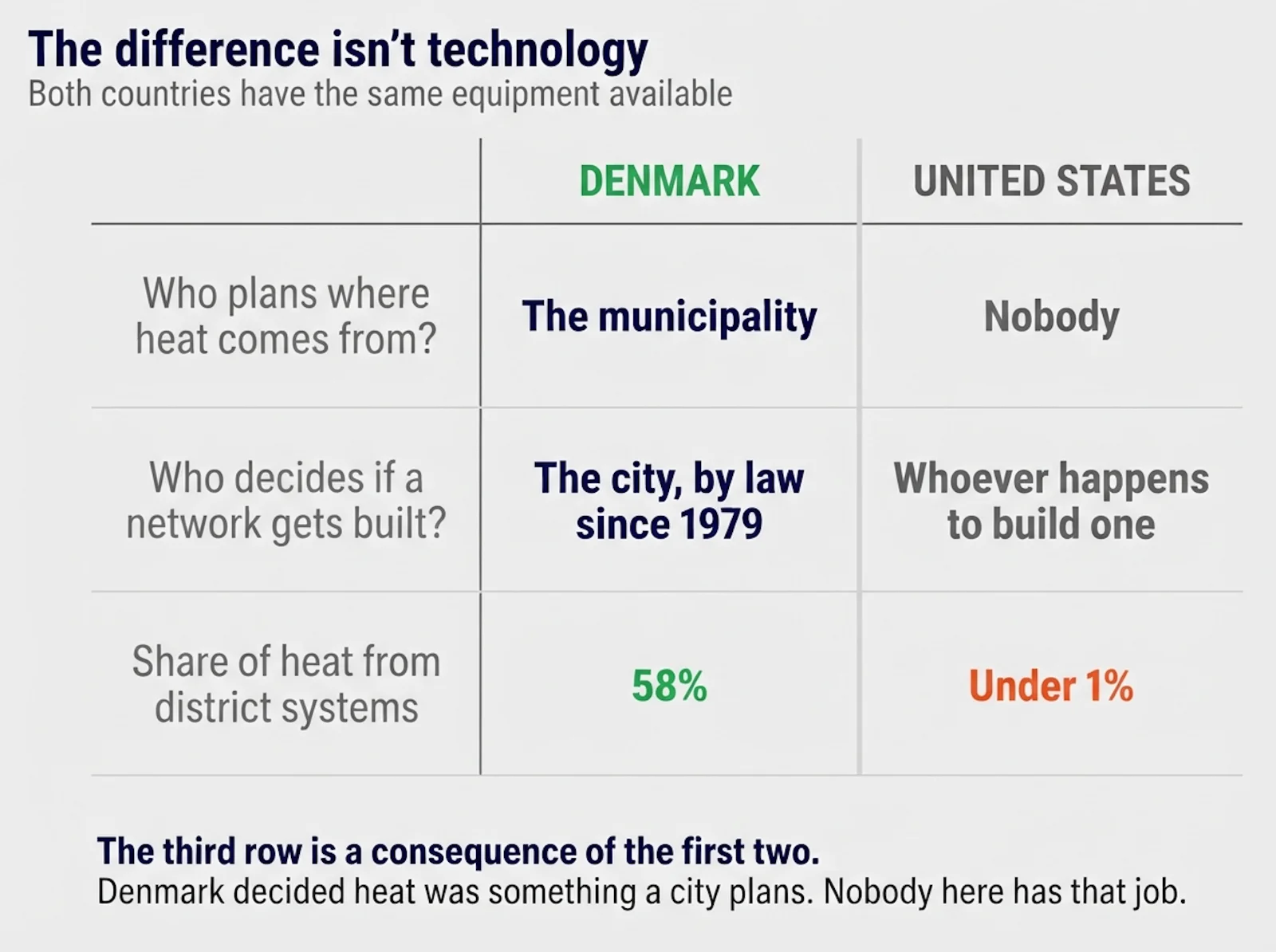
District heating supplies roughly 12 to 13% of heat demand across the European Union. In Denmark it runs between 50 and 66% depending on the measure and year. Sweden is around 55%. While Finland, Estonia, Latvia, Lithuania and Poland are all above half.
Roughly 19,000 district heating networks serve more than 77 million people across Europe. As of 2022, about 43% of the heat in those networks came from renewable sources or recovered waste heat.
The equipment isn’t exotic. Pipes, pumps, heat exchangers, increasingly heat pumps. The United States has all of it, and in the case of district steam, had it first.
What Denmark has that we don’t is a framework for deciding where it goes.
Denmark passed its first heat planning legislation in 1979, in the aftermath of the oil shocks, and regulates the sector through a Heat Supply Act. Danish municipalities are responsible for heat planning and zoning, and they have the final say on heat projects in their jurisdiction. More than 90% of Danish district heating networks are municipally or cooperatively owned, and they operate on a not-for-profit basis.
What Seattle already has
Denmark’s framework exists to answer one question: given the heat sources in a city and the heat demand in that city, what is the sensible way to connect them? Run that exercise in Seattle and you find most of what you would need already here, scattered across three systems that have nothing to do with each other.
The first is the steam network: 18 miles of pipe under downtown serving about 150 buildings including three hospitals, operating continuously since 1903. It’s privately owned, which means it makes its own decarbonization decisions on its own timeline and nobody else gets a vote.
The second runs underneath all of it. The wastewater system carries a continuous flow of warm water beneath the entire city, and King County’s first sewer heat recovery project is expected to supply roughly 70% of the heat for a 1.6 million square foot life science campus.
The third is the one nobody counts as thermal infrastructure at all. Data centers are, in practice, large electric heaters that perform computation on the way through, and the region is adding them.
A heat source, a bigger heat source, and a growing heat source, sitting in the same city with no relationship to one another. Not because connecting them would be hard, but because nobody has the authority or the mandate to try.
Compare that with Vancouver, two hours north. The False Creek Neighbourhood Energy Utility has been recovering heat from raw sewage since 2010, when it was built for the Winter Olympics. It now runs about 70% renewable, mostly from sewer heat. It expanded at the end of 2024 with two additional heat pumps adding 6.6 megawatts, and it’s targeting fully renewable operation by 2030, avoiding roughly 7,000 tons of carbon dioxide equivalent a year.
That’s not a technology Seattle lacks, it’s a decision Seattle hasn’t made.
The accounting problem underneath
There’s a reason heat gets left out, and it runs deeper than habit. Our policy instruments were built for electricity and don’t really work on much else. Renewable portfolio standards count electrons and carbon intensity factors are published per kilowatt hour. Interconnection queues, capacity markets, and resource adequacy are all electric sector machinery. If a thing can’t be expressed in megawatt hours, there’s no process waiting to receive it.
Which gives you a strong incentive to convert heat into something that can be. That’s what electrification does, in accounting terms as much as physical ones. Replace the gas furnace with a heat pump and the heat demand becomes electric demand, which means it now shows up in a model we already have, in units our instruments already measure.
That’s often the right answer, and heat pumps are extraordinarily efficient, delivering more than three units of heat per unit of electricity. But converting heat into electric load isn’t the same as planning for heat. It moves the demand onto a grid that, in this region, is at its tightest during exactly the hours heating demand peaks, and it ignores the heat that already exists and is currently being thrown away.
The part that should bother us
Everything described above is heat that already exists and is currently being destroyed on purpose.
A data center rejects nearly all the electricity it consumes as low grade heat. A wastewater main carries warm water under the street continuously, all year. A supermarket’s refrigeration system spends the day pumping heat out of its cases and into the parking lot. In every one of those cases somebody installed equipment, and pays to run it, specifically to move heat somewhere it does no good.
Then, a short distance away, another building burns fuel to make heat.
Stockholm and Helsinki have both stopped doing this, which is the part I find hardest to argue with. Those aren’t pilots or demonstrations, they’re operating utilities running ordinary businesses in cities with colder winters than ours.
So the gap isn’t technology, and at this point it isn’t really capital either. It’s that nobody here has the job of noticing that the heat leaving one building is the heat the building next door is about to pay for.
What I would actually like to see
I’m not proposing Washington adopt the Danish Heat Supply Act. Different country, different housing stock, different politics, and a forty-year head start we don’t have.
What I’d like is more modest: when a city or a state makes an energy plan, heat should be in it. Not as a footnote about building electrification, but as its own system with its own sources, its own demands, and its own map. Seattle is about to watch its largest thermal asset electrify. That’s a significant decision, made by a private company, with no particular obligation to coordinate it with anything else. It might work out well. It’s also the kind of decision that in Copenhagen would have been a planning question.
Where we fit
Pilotlight is a compliance platform for building performance standards, which is electricity and fuel accounting at the building level. It sits, in other words, squarely inside the machinery I’ve just described as incomplete.
What that work does produce is the raw material a heat plan would need. You can’t map a city’s thermal demand without knowing what individual buildings consume and when they consume it. Benchmarking data, collected building by building because the law requires it, is the closest thing this region has to that map.
If you’re not sure which standards apply to your building, our compliance navigator at pilotlight.ai/search will tell you in about a minute, and it’s free.
Sources
- Euroheat and Power, District Heating and Cooling Market Outlook
- Regulatory Assistance Project, Making Europe’s Homes Hygge: Danish Lessons on District Heating (January 2025)
- Reshape Strategies, Sewer Heat Recovery at the False Creek Neighbourhood Energy Utility
- The Tyee, The Future of Home Heating? It’s in the Dishwater (September 2024)
- CenTrio, CenTrio Seattle Advances Decarbonization with 25 MW Electric Boiler (October 13, 2026)